
Towards an ambitious target: Electric two-wheelers in India
An 80% market share of EV2W by 2030?
Let us understand how and where India has reached on this road and how far it needs to go.
Yo Bykes introduced India’s first electric scooter in 2006. This was a nascent phase of EV2Ws with vehicles powered by lead-acid batteries. These batteries had a remarkable ability to provide a high power surge to motor vehicles with starter motors. But they had certain disadvantages as well. Quick draining of these batteries was a serious limitation. Lead-acid batteries also took a very long time to charge. Despite these limitations, the world had begun to see the merit in electric vehicles, and it was only a matter of time when government policy would see the merit in aligning itself with a strong electric vehicle (EV) infrastructure.
FAME takes the stride
Fame ll was launched in 2019 with an outlay of Rs. 10,000 crores. It was remodeled in 2021 after feedback from industry and users. Repeated changes and disagreements regarding localisation norms have affected the functioning of FAME ll. This, however, has not stopped the green commuting solutions from growing.
Other government policies played an equally important role in propelling the EV industry. For instance, PLI, i.e., the Production Linked Incentive Scheme for the Automotive sector was launched in 2021, with a budgetary outlay of Rs. 25,938 Cr. to boost domestic manufacturing of advanced automotive technology to attract investments into the automotive manufacturing value chain. This scheme attracted a proposed investment of Rs. 74,850 Cr. against the target of 42,500 Cr.
Growth in electric scooters
What changed the consumer mind-set for electric scooters?
A lot has changed in electric scooters since 2006, and especially since 2015. There is a vast difference between the electric scooter of 2006 and the electric scooter of 2024. The first critical change is the battery. The lithium-ion battery revolutionised the EV scene, especially the EV2W scene. This battery is lighter, safer, and energy-efficient, has high energy density, needs a relatively shorter charging time, and has a much better range (distance covered per charge). It has a longer life.
The second significant change is the electrification of India. A few decades ago, we lived in India with chronic power failures or no power supply to several rural regions. Today, the power supply infrastructure is the single biggest success factor in the growth of EV2Ws all over the country.
Thirdly, today’s electric scooters have acquired several advanced features. They have lighter bodies, better ground clearance, tubeless tyres, better suspension, torque, and payloads. Manufacturing incentives have provided the resources to modernise EV two-wheelers in several ways. EV2Ws now have the latest technological features, ranging from keyless start to reverse gear, remote lock and theft alarms to GPS navigation, smartphone integration, and remote diagnostics. This has multiplied the benefits of an EV two-wheeler ride.
The fourth important factor is the price. There has been a drop in lithium-ion battery prices due to localised production. Despite the reduction in subsidies, an EV2W starts on an average of a little over Rs. 50,000 in India, definitely an affordable price for tier l, ll, and III cities/towns and, to an extent, even for rural India. Though a basic petrol two-wheeler starts around Rs. 28,000, most range upward of Rs. 50,000. Though there is purchase price parity in the basic models of petrol and electric 2Ws, in the long run, the maintenance cost of EV2Ws is nothing compared to petrol two-wheelers.
The fifth vital factor is eliminating license and helmet requirements for slow-speed electric two-wheelers. Anyone above the age of sixteen can drive these vehicles without a license, while a license to drive a petrol two-wheeler can be acquired only at the age of eighteen.
Last but not least is competition. There are several EV2W brands jostling for the consumer mind-space. Competition always ensures better pricing and faster advancement.
Current market trends in electric scooter sales
Major players in the electric-two-wheeler markets include Hero Electric, Okinawa Autotech, Greaves Electric Mobility Pvt. Ltd., Ather Energy Pvt. Ltd., PuREnergy Pvt. Ltd., Ola Electric Pvt. Ltd., TVS Motor Company and Revolt Intellicorp Pvt. Ltd. among others.
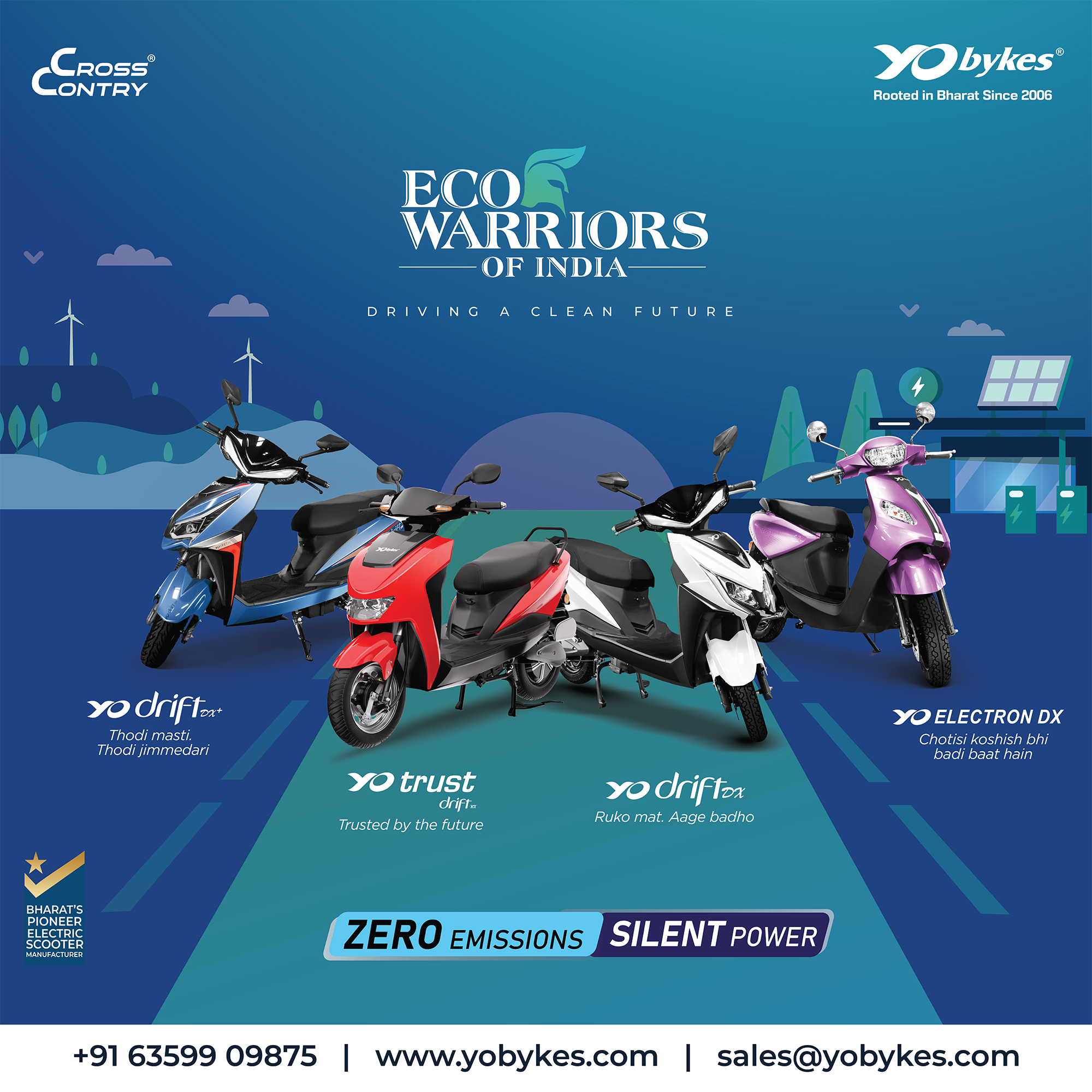
Yo Bykes electric scooters is the pioneer in EV2Ws in India. It introduced India’s first two-wheeler in the year 2006. It has now launched four EV2W models. Looking at the high demand for moderately priced EV2Ws, Yo Bykes has struck a fine balance between affordable pricing and rich features
Future trends for electric scooters
Everything must fall in place for any idea to flower and prosper. EV2W is in that fortunate space. Roads, connectivity, electrical Infrastructure, government support, technological advances, and consumer interest are all in place. And the results are evident in the fast-rising sales figures. This trend looks poised to continue.
Government policies have encouraged local lithium battery manufacturing to keep up with the massive demand. This is showing results in cost reduction. Exploring alternatives to lithium is also on the agenda. Solid state sodium-ion batteries are showing great promise. Sodium ions will replace lithium ions in these batteries. Sodium is available in abundance in nature. Hence, sodium-ion batteries will become game-changers in this industry.
Another area where one will see a sea change is in charging. Future trends suggest not just public charging Infrastructure but also facilities for wireless charging. Wireless charging will do away with plugs and enable parked scooters to get charged through coils in the parking lots.
In terms of material improvements, the industry is making significant strides. Lightweight materials like aluminum, magnesium, and carbon fiber are on the horizon. Material advances are poised to improve the performance of EV2Ws in terms of stability and longevity.
The market buoyancy, rapidly evolving technology advancements and consumer interest are suggesting a very interesting growth in the near future.